
- Smart industries
- Karno Energy
One network that warms a district in winter and cools it in summer
Karno Energy's networks move local and recovered heat between homes, schools and businesses, and the computers that measure and control them were once smartphones taken out of service in Europe
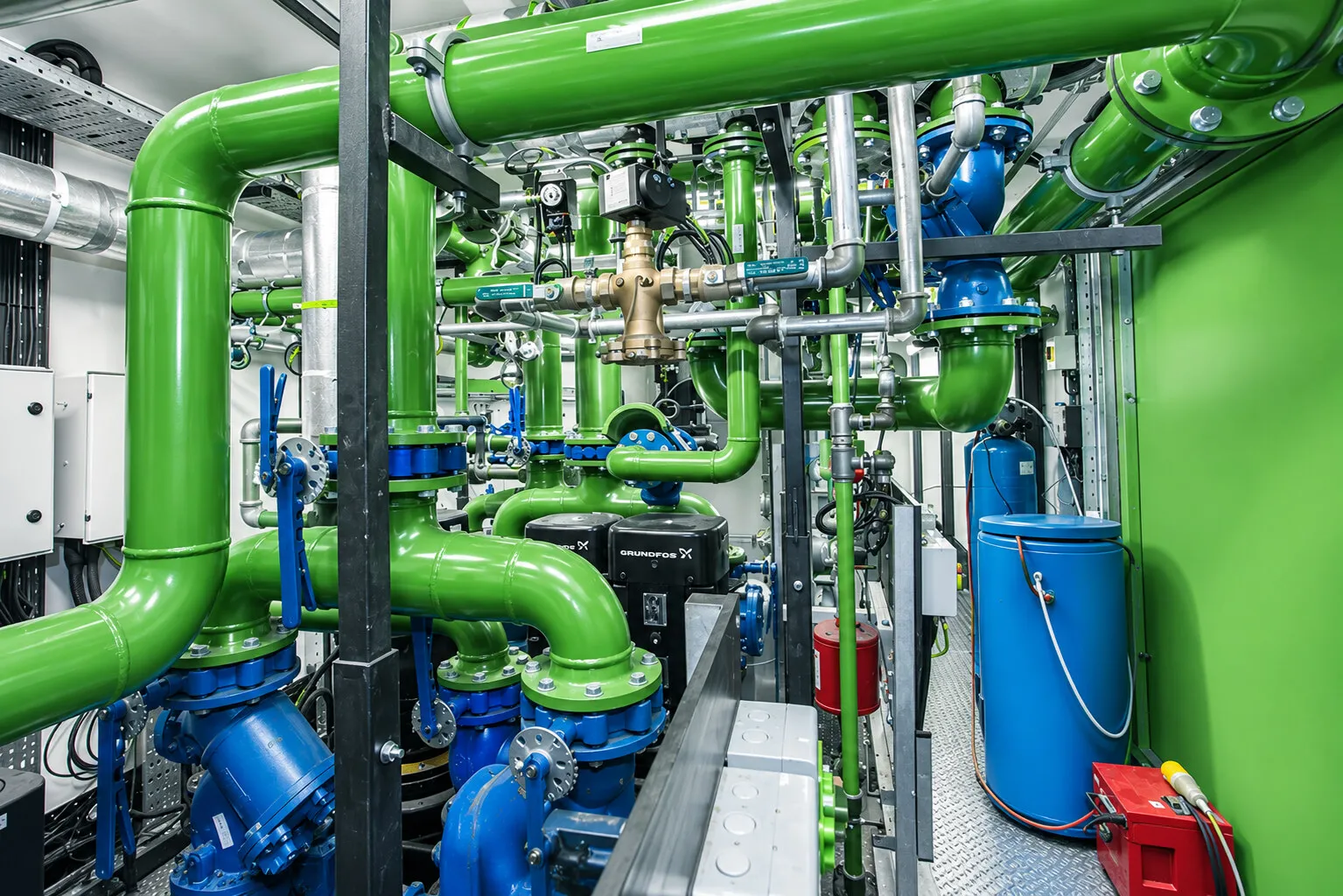
Karno Energy designs, builds and operates heat networks in Belgium. A heat network moves heat between the buildings of a district, warming them in winter and cooling them in summer. Because Karno Energy operates what it builds, it has to know what each site is producing and what each building has used. A unit of its own reads every site and sends what it finds to the platform its teams work from. The computer inside that unit was once a smartphone taken out of service in Europe.
 Challenge
Every building has to be measured, and no two sites are built the same way
Every building connected to a network pays for what it has actually used, so the heat going into each one, and the heat taken out of it, have to be measured before anyone can be billed. The installation has to be watched closely enough that a fault is found and repaired quickly. And heating and cooling cost least at the hours when electricity is cheapest and cleanest, which are rarely the hours when they would otherwise be produced.
None of that is difficult on a single site. It becomes difficult because no two sites are built the same way. One network warms a few blocks of apartments, another a cluster of houses, another a mixed district where homes, offices and public buildings draw from the same source. Each installation was built by a different team, with its own machinery, its own meters and its own controls. A unit that fits one site but not the next is of little use to an operator who has to run them all together.
Whatever is installed has to keep working on its own in a technical room for years, and warn the operator when it fails. When a site stops sending its readings, there is nothing left to build its bills on.
 Solution
One unit that fits every site, whatever equipment is already there
The unit at each site is Karno Energy's own, and the computer inside it comes from Citronics, which recovers computers from smartphones taken out of service in Europe, then tests them and approves them so that a product can be designed around one. A phone leaving service still holds a capable computer and the connections such a unit needs. That left Karno Energy's engineers free to work on the part of the unit that connects to the installation, rather than on the computer underneath it.
The rest of the unit is built for the installation. It connects to the controls where the network's machinery sits and reads how the installation is running, the temperatures, the pressures, the flows and the state of each machine, along with the heat meters of the buildings on the network. Where the building's electricity is metered, it reads that too. It works with the control systems already installed, whichever ones a site happens to have, so one unit fits them all.
What it collects travels over a protected link to Karno Energy's platform. The unit also reports on its own condition. And where the installation accepts it, it tells the heat pumps to run at the moments that suit the network, when there is more solar electricity than the site is using or when power is at its cheapest.
 Benefits
One way of running every site, and heat billed as it was measured
A set of separate installations becomes something a single team can run, and every building is billed for the heat it actually used.
Because each unit says how it is doing, a site in difficulty is seen from the office instead of discovered when its readings stop, and an alert when a site begins to drift lets a fault be repaired before the people in the buildings notice anything.
Heat made while the solar panels are producing, or while power is cheap, costs less than the same heat made three hours later, and a network that can be told when to produce makes that saving every day of the year, in summer for its cooling as much as in winter for its heat.
The computer inside each unit is recovered and prepared in Europe, from equipment already on the continent, so there are fewer places where its supply can break.
Circular computing allows us to deploy reliable, industrial-grade infrastructure while staying aligned with our environmental convictions: decarbonizing heat using equipment whose own manufacturing footprint was cut too.
 Gregory MeysCEO, Karno Energy