
- Smart cities
- Aeonics
- Blinqy
An ambulance that knows what it is carrying, and keeps that knowledge on board
A proof of concept built with Aeonics and Blinqy, running on a computer recovered from a retired smartphone
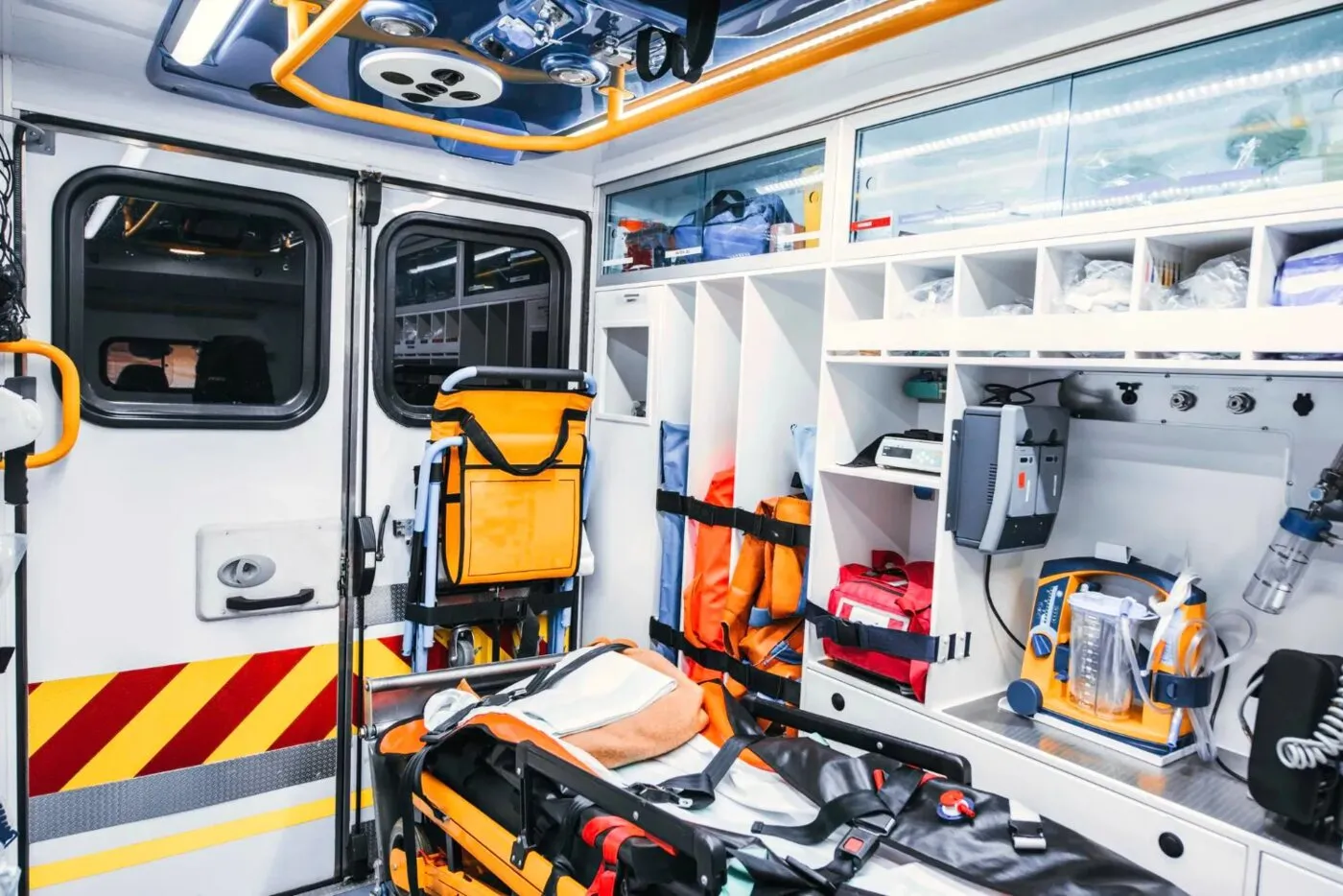
An ambulance leaves for a call carrying a defibrillator, oxygen, bags and monitors, and the crew has to be able to count on every one of them being there. Checking by hand takes time a crew does not always have. Aeonics and Blinqy built a system that does the counting by itself. Small tags, each with its own battery, travel with the equipment and announce themselves over a short radio link. A unit in the vehicle listens to them, works out what is present and what is missing, and follows where the vehicle has been. What is unusual about the system is that this work happens inside the ambulance. The detail of where the vehicle goes and when stays in the vehicle rather than travelling to a distant server. The computer doing that work was recovered from a smartphone taken out of service, then prepared for reuse by Citronics. The system was proven in a working proof of concept.
 Challenge
Power to last the shift, discretion about where the vehicle went
Emergency vehicles are checked before and after every shift. A missing item found at the start of a call is a problem, and one found during a call is a far greater one. Having each item account for itself removes that uncertainty, and it brings two difficulties with it.
The first is power. A unit that listens continuously, knows where the vehicle is and stays reachable has to keep doing so through a full shift and through the hours the vehicle sits parked, on the battery it carries, without leaning on the vehicle.
The second is the information itself. Where an ambulance goes and when it goes there says a great deal about the people it serves and the crew that serves them. An emergency service has good reasons to want that detail to stay with the vehicle. There is a practical side to it too, because a vehicle in motion does not always have a connection to send anything anywhere.
 Solution
One small assembly listens, locates, connects and decides
The unit in the vehicle was built on a circular compute module from Citronics, a computer and its connections recovered from a smartphone that had been withdrawn from use, then tested and qualified so that a product can be designed around it. A phone holds, in one small assembly, processing power, mobile and wireless connections and satellite positioning, which happens to be the whole list of what this unit needs.
Aeonics' software runs on that module, inside the ambulance. It receives what Blinqy's tags broadcast, works out what it means, and keeps the result locally. The vehicle sends out what someone actually needs to see rather than a continuous stream, so the system keeps working where coverage is poor and the detail of the vehicle's day stays where it was produced.
The same arrangement answers the question of power. One assembly does the listening, the locating, the connecting and the thinking at once, and it is built from the kind of electronics that go into mobile devices, where working sparingly from a battery is the first requirement.
 Benefits
Proven for an ambulance, usable by any fleet that carries equipment
Through the proof of concept the unit ran for 20 hours on a single battery with positioning, mobile connection, local radio and tag reading all active, which covers a working shift and the parked hours that follow it. It read every tag it was asked to read, five out of five over an hour, in conditions deliberately crowded with competing radio traffic. It logged no hardware incident across the test period, and if a fix or an update should occur, it would take no more than a couple of minutes.
Because the work happens in the vehicle, the data leaving it is around 95% less than it would be if everything were sent out as it happened. The equipment counts too. Reusing a computer instead of manufacturing one avoids in the order of 17.7 kg of CO2 equivalent per unit.
The proof of concept was built for an ambulance, and nothing in it is particular to ambulances. The same unit, the same tags and the same habit of keeping the thinking on board suit a fire service, a construction site or a logistics fleet that needs to know where its equipment is.
20 h
on one battery
a full shift and the hours parked, proof of concept conditions
5 out of 5
tags read, every time
over an hour, in crowded radio conditions
95%
less data leaving the vehicle
against sending everything out as it happens
The Citronics platform came with the standard tools our engineers already prefer, so there was nothing to learn before we could start building. Our effort went into the software the job needed rather than into getting a computer to cooperate. For a small team, that is what makes a project like this one worth taking on.
 Simon UyttendaeleCEO, Aeonics
We started on a readily available prototyping board, integrating GPS and Bluetooth capabilities with Ubuntu Linux running on top. That meant we were directly working on complete, integrated hardware permitting to accelerate the time-to-prototype.
 Thibaut WiameManaging director, Blinqy